Published cartoon ·
Staff Meeting Archeologist
Every mysterious requirement has a buried decision beneath it.
Why this one bites
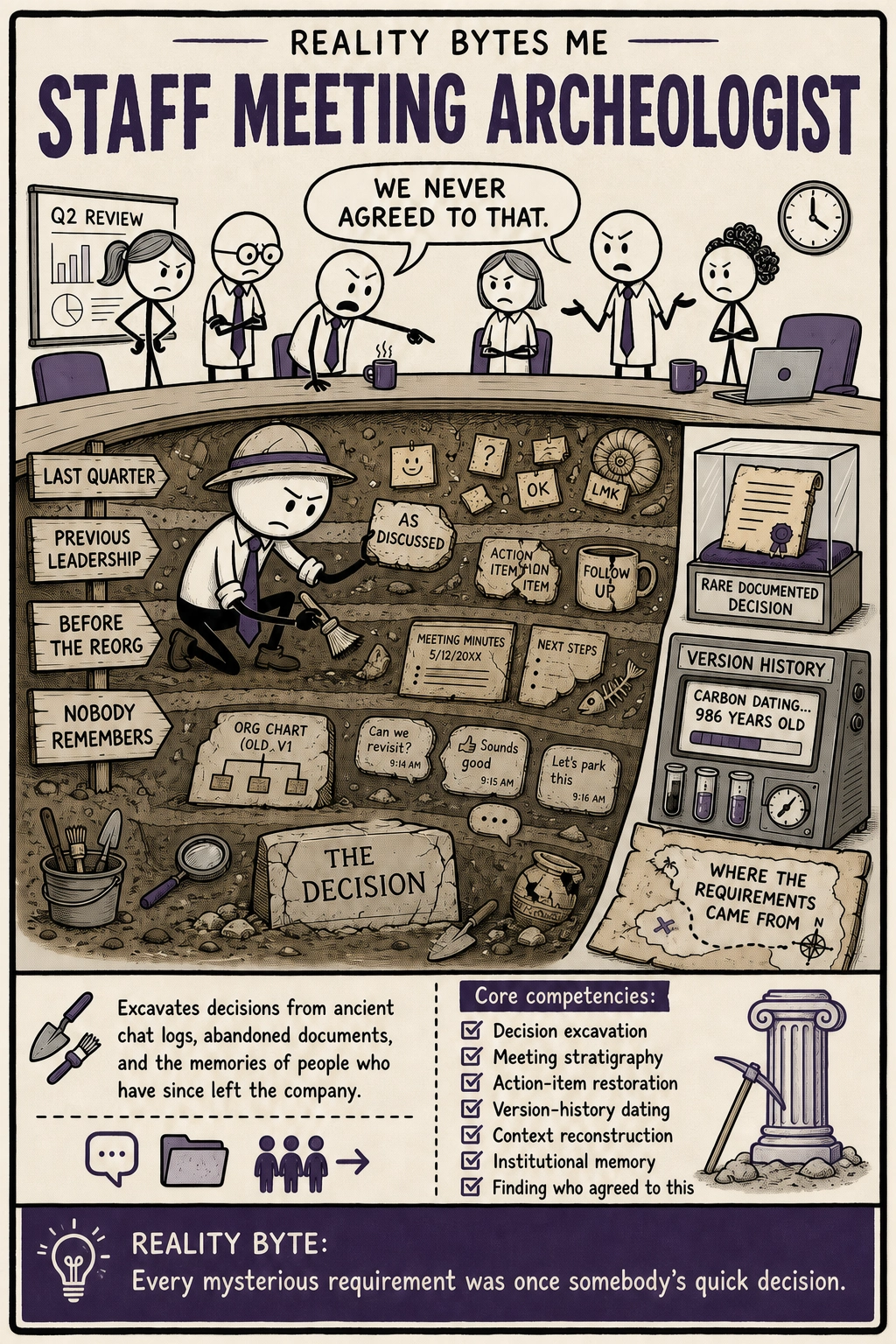
A meeting denies that an agreement ever happened. Below the table, the archeologist searches through layers of old messages, minutes and organisational history for evidence of the decision. Yesterday's quick agreement has become today's undocumented inheritance.
The excavation gives institutional memory a visible maintenance cost. When decisions lose their owners and reasons, somebody must reconstruct them before the next decision can be made. The absurd museum treatment of a documented agreement suggests how rare a complete record has become.
Accessible summary
- The upper scene shows colleagues disputing an agreement. Beneath it, an archeologist digs through layers labelled Last Quarter, Previous Leadership, Before the Reorg and Nobody Remembers.
- Artifacts include meeting minutes, an old organisation chart and fragments of follow-up language. A rare documented decision sits in a display case, beside a map of where the requirements came from.
Reading notes
A decision record needs more than a conclusion. It needs the question being answered, the relevant assumptions, the people authorized to decide and a reason that will still make sense after those people change roles. Without that context, a surviving document can prove that something happened while failing to explain why anyone should continue doing it. The archeologist must reconstruct the missing relationship between the artifact and the work.
Reorganizations make this especially expensive. A new group inherits a system whose constraints were negotiated by an older group, using names and priorities that no longer exist. Someone remembers an exception; someone else remembers a different promise. Both may be sincerely describing different moments. The excavation metaphor makes institutional memory a resource that can be lost even when every message is technically still stored somewhere.
The rare documented decision in the display case is the comic reversal. Something that should be ordinary becomes a museum-quality discovery. The remedy is not to preserve every conversation in ever larger archives. It is to maintain a small, findable account of the decisions that still govern the work, including when they should be reconsidered. Otherwise tomorrow's meeting will once again begin by denying yesterday's agreement and sending someone below the table to search for proof.