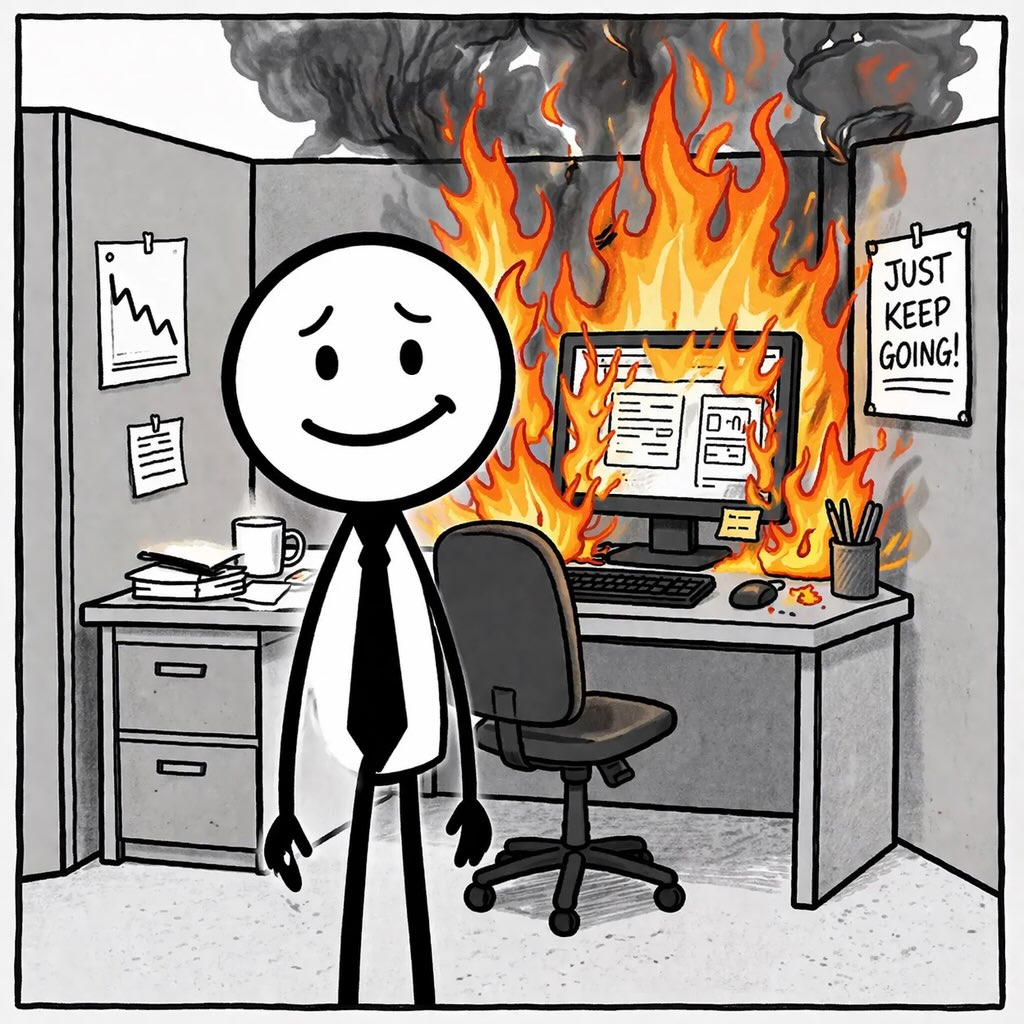
Published cartoon ·
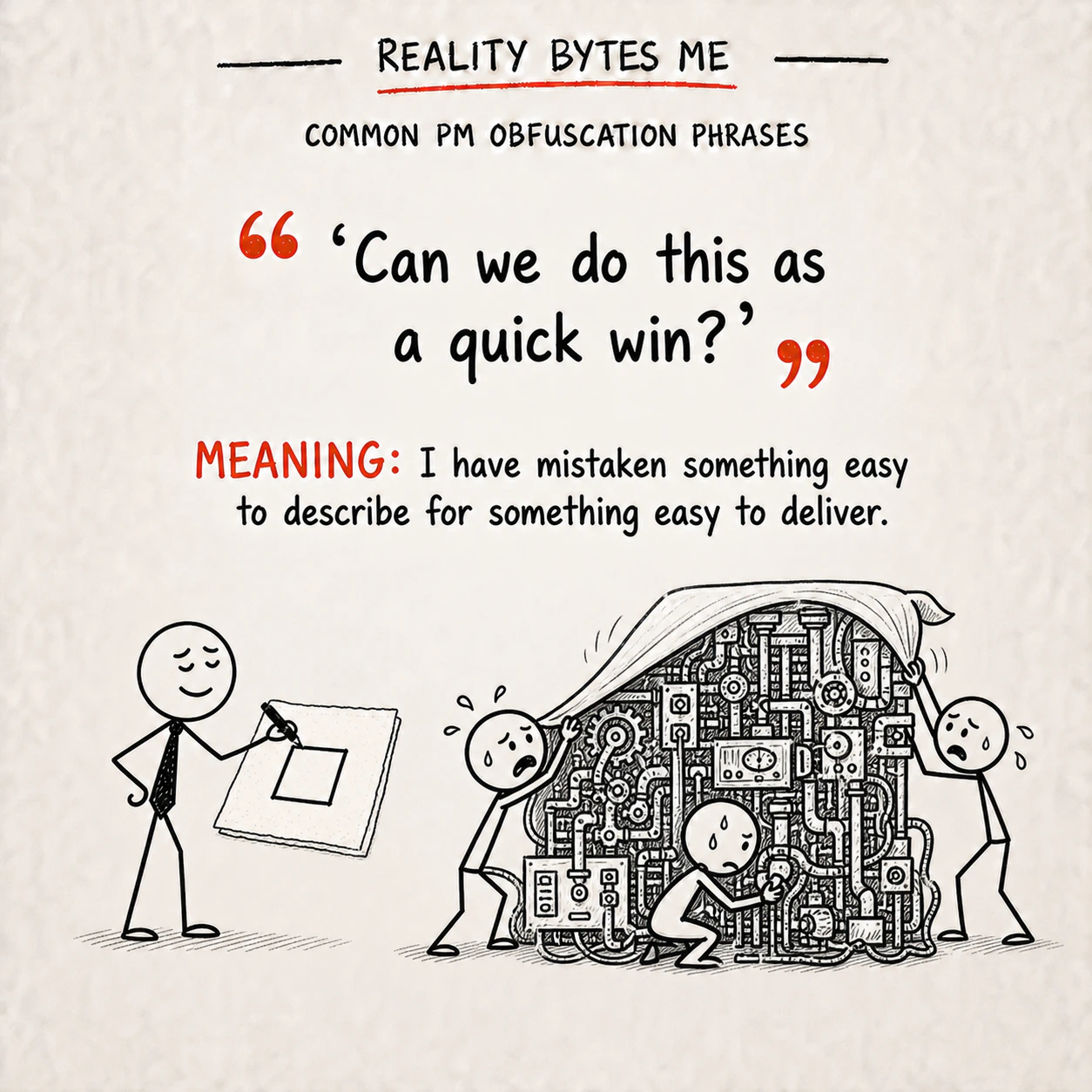
Can we do this as a quick win?
Easy to draw. Somebody else's problem to deliver.
Why this one bites
A manager sketches a simple square while the team struggles with a dense mass of machinery. The simplicity belongs to the request, not to the system needed to fulfil it. Calling the result a quick win quietly decides the effort before that effort has been understood.
The covered machinery is the hidden implementation behind a clean idea. The joke exposes a mismatch in what the two sides can see: one sees the outline of the outcome, while the other must make every connection inside it work.
Accessible summary
- A manager draws a small square on a pad. Three distressed workers uncover and work on an enormous, intricate machine.
- The caption describes mistaking something easy to explain for something easy to deliver.
Reading notes
The square is an excellent description of a desired shape. It says almost nothing about the connections needed to produce it. In software or operations, a tidy result may depend on permissions, data quality, compatibility, support procedures and systems owned by other teams. These are not decorative complications added by reluctant implementers. They are part of what makes the simple result work beyond the presentation.
Calling the work quick before examining those dependencies reverses the order of estimation. The label becomes an expectation that the estimate must satisfy. When the team discovers more work, the discovery can be heard as a failure of attitude rather than new information. People then spend time defending the complexity instead of reducing it. A supposedly efficient phrase has created an additional task: explaining why the phrase was premature.
A genuine quick win has a bounded outcome and a credible path to it. The team knows what can be reused, what must be changed and what will remain outside the first release. That definition can still be ambitious. It simply makes the effort visible before claiming the result is easy. The machinery in this drawing is the part normally hidden behind a clean square on a slide, waiting for somebody to ask how the square is powered.