Published cartoon ·
The Naysayer
Workplace satire from RealityBytesMe.
Scene and commentary
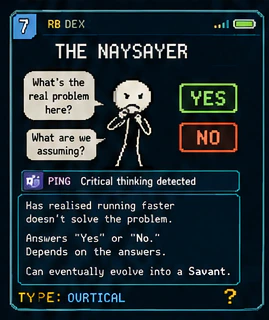
The Naysayer looks thoughtful rather than triumphant, asking what the real problem is and which assumptions are being made. Green YES and red NO indicators sit beside the character. Despite the name, the card explains that either answer is possible and depends on the answers to those questions. A notification identifies critical thinking, while the description suggests a possible evolution into a Savant. The apparent negative character is therefore one of the collection's more conditional thinkers.
The name sets up a deliberate reversal. In a room accustomed to immediate agreement, a request for evidence can sound like opposition. The cartoon asks whether the label tells us more about the questioner or about the room's tolerance for questions. Someone who wants to understand the problem before approving a solution may be protecting the proposal from avoidable failure rather than trying to prevent it from happening.
The two answer buttons matter because criticism is useful only if it can respond to information. A person who always says no regardless of the evidence would be a different creature from the one described here. This Naysayer can be persuaded. The standard is not enthusiasm or reluctance but whether the proposed action addresses the actual problem under the conditions that exist.
That distinction becomes practical when a team is asked to run faster. Faster execution helps only if the chosen work is worth executing and the obstacle is speed. If the real obstacle is an unresolved decision, adding effort can increase the amount of work that later needs to be undone. Asking about assumptions creates an opportunity to discover that mismatch before it becomes expensive.
The card invites both sides of a conversation to improve. The questioner should make the concern specific and explain what information would change the answer. The proposer should treat a relevant question as part of developing the plan, rather than as a loyalty test. The YES and NO indicators then become outcomes of reasoning instead of permanent personality traits. That is the difference between a useful challenge and an argument that has already decided never to end.