
Published cartoon ·
The Spacehamster
Workplace satire from RealityBytesMe.
Scene and commentary
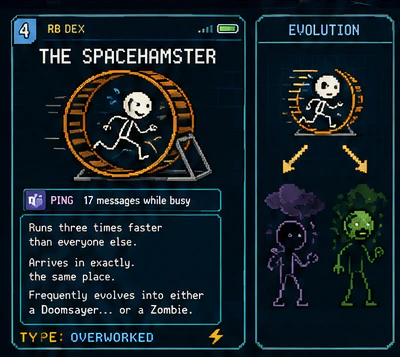
The Spacehamster runs inside a glowing wheel while a notification reports seventeen messages arriving during its busy period. The card says it runs much faster than everybody else yet reaches the same place. Its evolution panel branches towards the Doomsayer and the Zombie, two different fictional responses to effort that produces no visible movement. The image gives frantic activity a literal circular shape: every step is real, but the route returns to its starting point.
This is not a joke about laziness. The Spacehamster is visibly exerting itself. The problem is the relationship between effort and outcome. Repeated status requests, changing priorities and unfinished handoffs can consume a working day without moving the underlying task closer to completion. Counting messages answered or hours spent would capture that activity while missing the absence of progress.
The notification is important because the wheel is not an entirely private choice. The surrounding organization keeps adding demands while the employee is already busy. Each interruption may seem small to its sender. Together they can leave no protected period in which a difficult piece of work can be finished. The person then compensates by running harder, which makes them look productive enough to receive still more requests.
The two fictional evolutions distinguish frustration from disengagement. A person may begin explaining why every new proposal will fail, or may stop investing much attention in proposals at all. Those are narrative possibilities in the cartoon, not predictions about any particular employee. They direct attention to the conditions around the person rather than assuming that a change of attitude appeared from nowhere.
The useful question is which part of the wheel can be removed. That might mean limiting simultaneous work, reducing duplicate reporting or deciding which request must wait. Encouraging the runner to improve personal efficiency cannot resolve an unlimited queue by itself. A visible finish line and permission to ignore lower-priority interruptions give effort somewhere to go. Without them, the organization risks celebrating the speed of a machine whose defining feature is that it never travels.