Published cartoon ·
The Weather Vane
Workplace satire from RealityBytesMe.
Scene and commentary
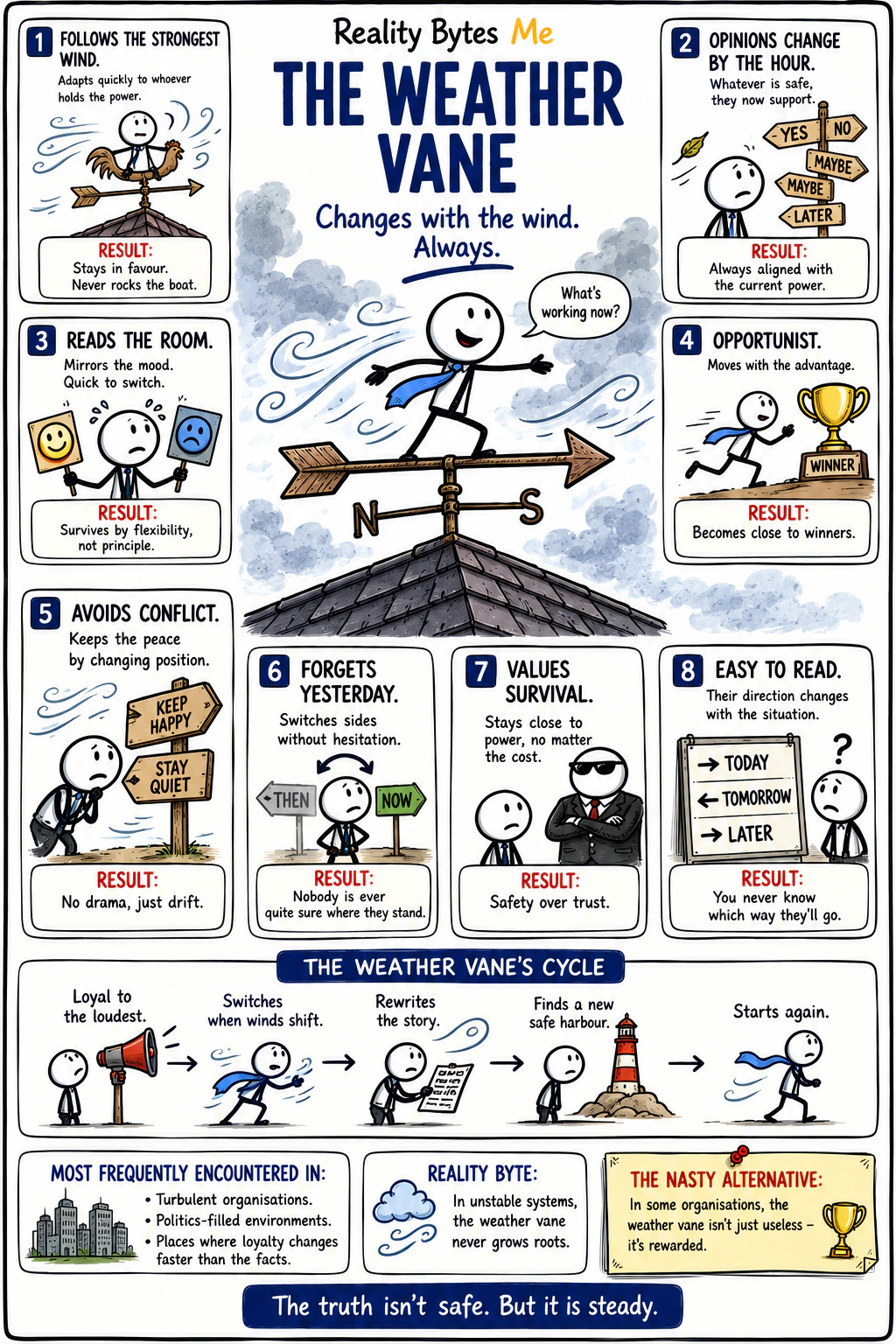
The Weather Vane balances on a rooftop arrow while wind pulls at a blue tie. Eight surrounding scenes show opinions following power, expressions changing with the room, loyalty moving towards a winner and yesterday's position being replaced without hesitation. A closing sequence follows the loudest voice, a shift in the wind, a rewritten account and a new safe harbour. The figure remains active and adaptable, but the picture offers no stable destination beyond personal safety.
Changing a view can be a sign of good judgement when evidence changes. The cartoon instead identifies the source of the change as advantage and authority. A Weather Vane can agree convincingly in several different meetings because each room has a different prevailing wind. The resulting statements are difficult to use as commitments: they describe the immediate setting more reliably than the speaker's considered position.
The two mood signs make that social sensitivity visible. Reading a room is often a useful skill, especially when it helps someone communicate a difficult point clearly. Here it becomes a substitute for having a point that can survive the room. Conflict is avoided by moving the speaker's position, leaving others to discover later that apparent support was temporary.
The panel about forgetting yesterday exposes the coordination cost. Teams need to know which assumptions and decisions remain in force. When a change is neither acknowledged nor explained, colleagues may continue acting on an earlier understanding while the leader has already adopted another. The person following the wind stays aligned with power; the people following the stated plan are left facing the wrong direction.
A useful reading asks for an account of what changed and why. New evidence, a revised goal or an explicit trade-off can justify a different decision. Naming that reason preserves a shared history instead of silently replacing it. The environment matters too: if disagreement is punished and alliances determine safety, weather-vane behaviour may be rewarded. The page therefore questions both the individual habit and the conditions that sustain it. Flexibility helps an organization when it responds to reality; it undermines trust when it responds only to whoever currently appears strongest.