Published cartoon ·
The Mushroom Farmer
Workplace satire from RealityBytesMe.
Scene and commentary
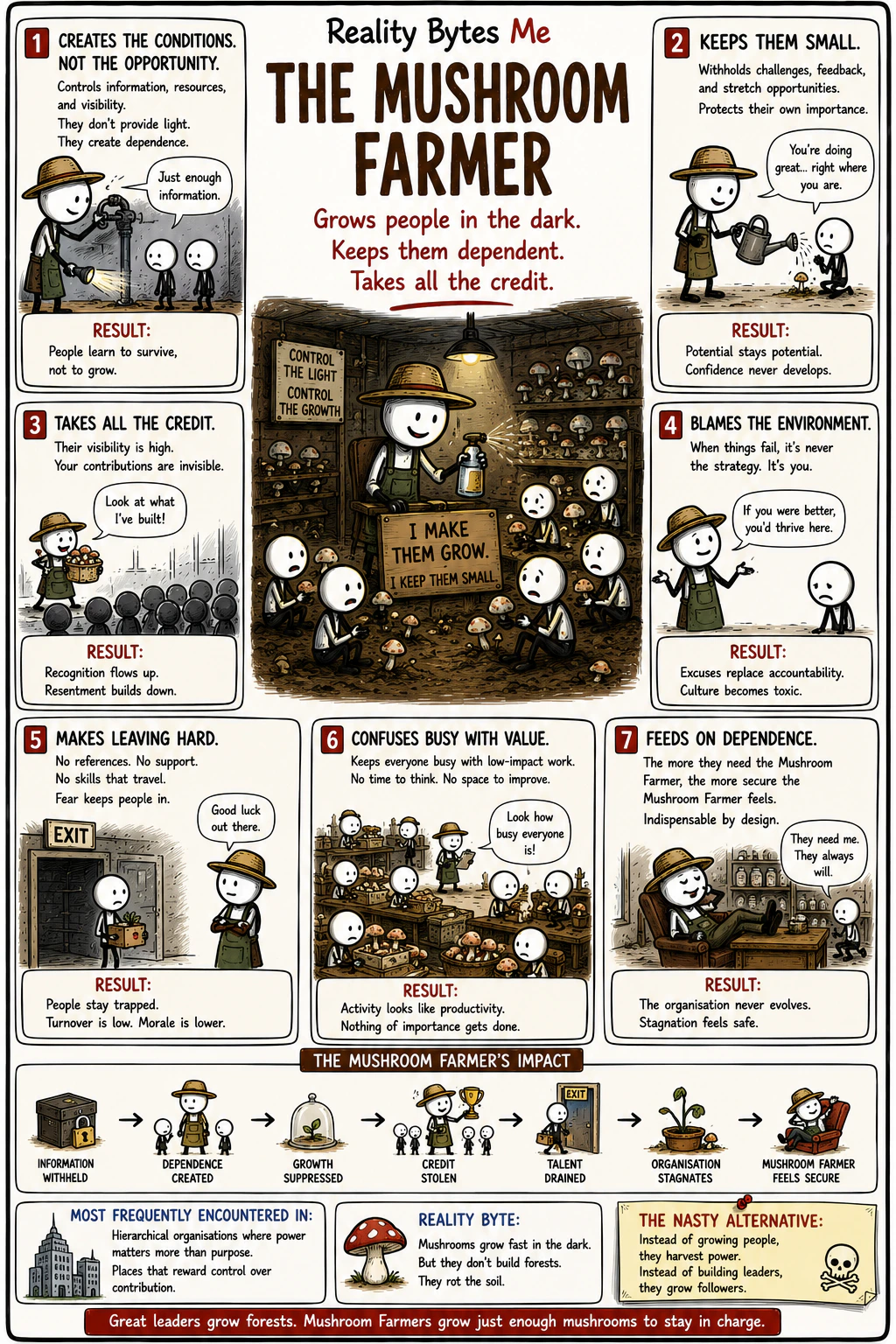
The Mushroom Farmer tends a dim underground room where employees sit among mushrooms beneath a single light. A sign links control of the light with control of growth. Surrounding scenes ration information, withhold challenges, claim credit and discourage departure. A busy team remains confined to small tasks while the farmer celebrates being needed. The final sequence follows withheld information through dependence and stalled development to a manager who feels secure in the resulting arrangement.
The page is a darker counterpart to the Gardener. Both figures shape an environment, but they seek different outcomes. The Gardener develops people who can act with increasing independence. The Mushroom Farmer provides enough support to keep work happening while limiting the opportunity to become less dependent. The difference is not whether the manager is involved; it is what that involvement allows other people to become.
Information is central because it determines how far someone can reason beyond an assigned instruction. A worker who receives only fragments may be able to complete a task but not understand the decision behind it. That makes the manager necessary for every exception. Over time, the resulting dependency can be presented as evidence of the manager's unique importance rather than as a condition the manager helped maintain.
The departure panel shows another cost. Development should leave people with skills and confidence they can use in a wider setting. Here, limited exposure and discouraging messages make leaving feel difficult. Low turnover can therefore be misread as loyalty when the cartoon is depicting a lack of opportunity. A single metric cannot reveal whether people stay because they are flourishing or because they feel unable to move.
A practical reading asks whether team members gain context, meaningful decisions, useful feedback and chances to take on unfamiliar work. Those opportunities should not depend entirely on one person's private approval. The farmer's harvest may look impressive from the stage where credit is collected, but the room underneath tells another story. The measure of development is not how often people need the manager tomorrow; it is whether they are becoming better equipped to understand and handle the work themselves.