Published cartoon ·
The Fortune Teller
Workplace satire from RealityBytesMe.
Scene and commentary
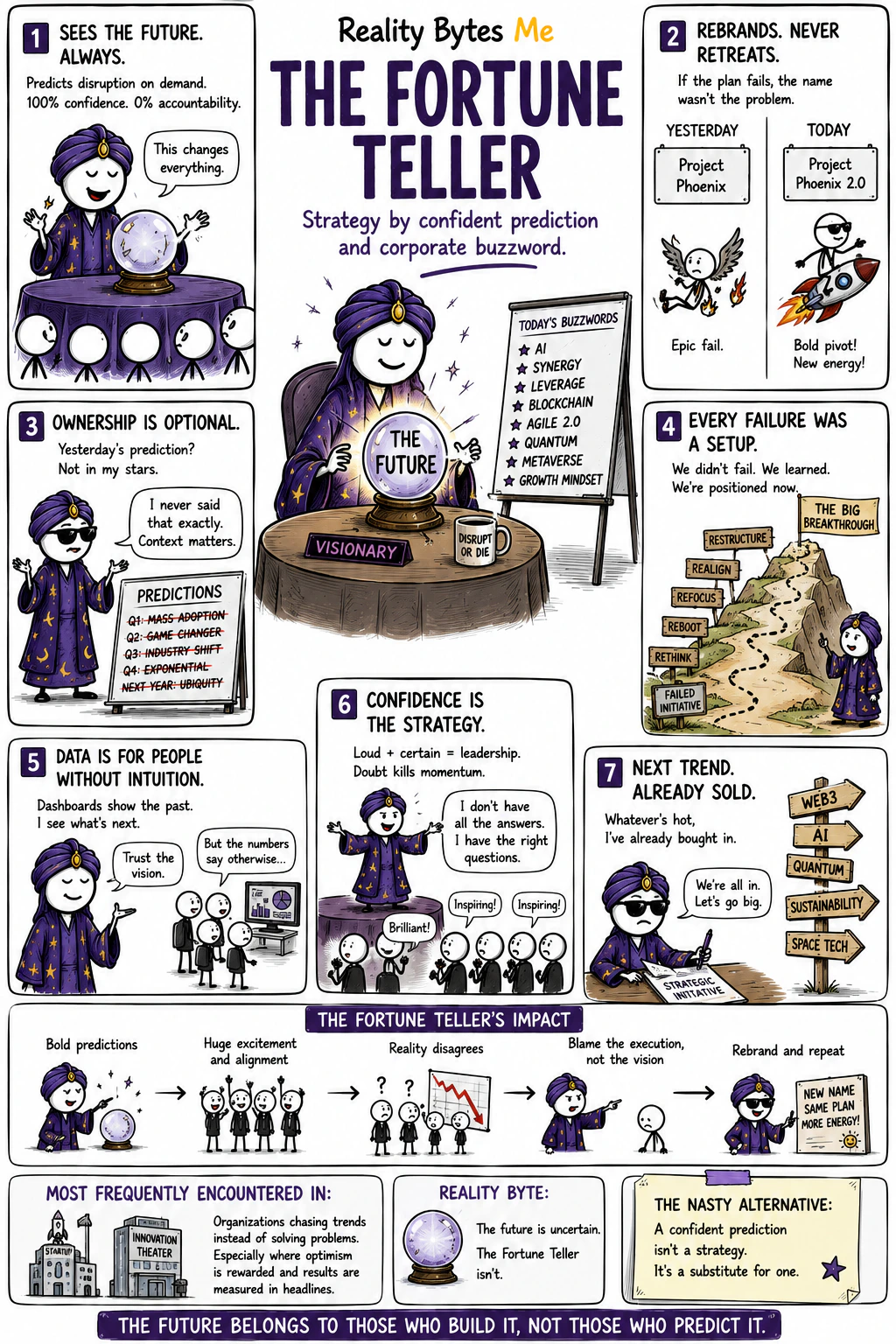
The Fortune Teller sits before a crystal ball labelled the future, surrounded by a list of fashionable strategic terms. Seven scenes show confident predictions, a failed project relaunched under a new name, old forecasts disowned and a mountain path that continually renames setbacks as preparation for a breakthrough. A closing sequence moves from excitement to disappointing results, then to blaming execution and rebranding the plan. The costume makes prediction into a performance with its own props and audience.
The target is not planning for uncertainty. Organizations must make choices about futures they cannot know completely. The Fortune Teller instead removes uncertainty from the presentation while leaving it fully present in the work. Confidence substitutes for an account of assumptions, evidence and possible alternatives. The audience receives a compelling destination without a reliable explanation of how the route will be tested.
The rebranding panel shows how the performance protects itself. A revised plan can be a sensible response to new information, but a new name alone does not establish that anything was learned. If the original prediction disappears, the organization loses the ability to compare expectation with outcome. Every attempt can then begin with fresh excitement while carrying forward the same unexamined weakness.
The rejection of data adds another shield. Evidence about current conditions is dismissed as backward-looking, while the vision claims privileged access to what comes next. There is a real distinction between present measurements and future possibilities, but it does not make present constraints irrelevant. A strategy needs to explain why those constraints can be changed or worked around, not merely announce that imagination outranks them.
A useful reading asks what would cause the proposal to be revised. Which assumptions can be tested early, which result would count against the forecast and who owns the decision to continue? Those questions make room for ambitious ideas without treating enthusiasm as proof. The crystal ball is funny because its authority cannot be inspected. A workable strategy should offer the opposite: a visible chain from the problem through the chosen actions to evidence that the hoped-for change is actually beginning to occur.