Published cartoon ·
Senior Sarcasm Developer
Technical accuracy has stopped trying to sound enthusiastic.
Why this one bites
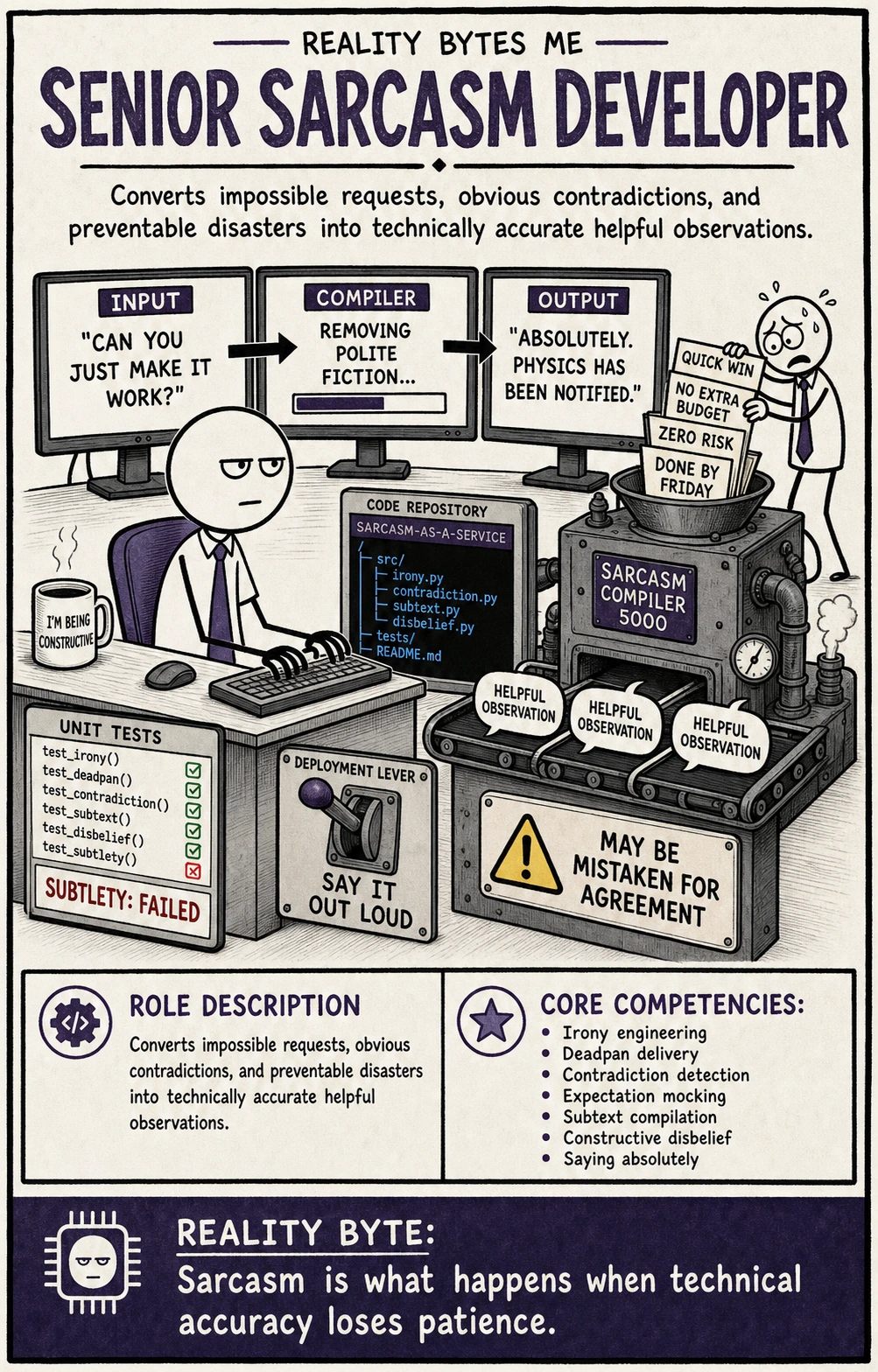
An impossible request enters a compiler and emerges as a perfectly deadpan observation. The machine removes polite fiction, leaving an answer that acknowledges the words of the request while exposing its contradiction. A warning notes that this may still be mistaken for agreement.
The joke gives professional frustration a software pipeline. Sarcasm expresses what a direct warning has failed to communicate, but it introduces a new risk: someone may record the apparent yes and miss the meaning. Even the tests concede that subtlety has failed.
Accessible summary
- Three screens show a request to make it work, a compiler removing polite fiction, and an answer saying physics has been notified. Another employee feeds demands for speed, no extra budget and zero risk into the machine.
- The output consists of helpful observations, with a warning that they may be mistaken for agreement. The final line describes sarcasm as technical accuracy losing patience.
Reading notes
Sarcasm works by asking the listener to notice a gap between the literal sentence and the situation. That makes it satisfying when everyone shares the context and risky when the sentence travels alone. A deadpan yes can be copied into meeting notes long after the warning in the speaker's tone has disappeared. The organization then retains evidence of agreement while the person who spoke remembers having expressed the opposite.
The compiler metaphor gives this communication failure a technical shape. An impossible input is transformed into a statement that exposes its contradiction, but the receiving system does not understand the transformation. It reads the output as an ordinary commitment. The tests have found a compatibility problem between technical accuracy and managerial optimism, and no amount of dry delivery guarantees that the receiver will decode it correctly.
Humour can make a difficult truth discussable. It cannot replace an explicit account of the constraint when a real decision depends on it. The safest companion to the joke is the plain version: which requirement conflicts with which other requirement, and what choice is needed. The cartoon leaves that tension intact. Sarcasm offers relief from repeatedly explaining reality, while creating the alarming possibility that reality has just been recorded as having approved the plan.