Published cartoon ·
No authority, no accountability
Workplace satire from RealityBytesMe.
Scene and commentary
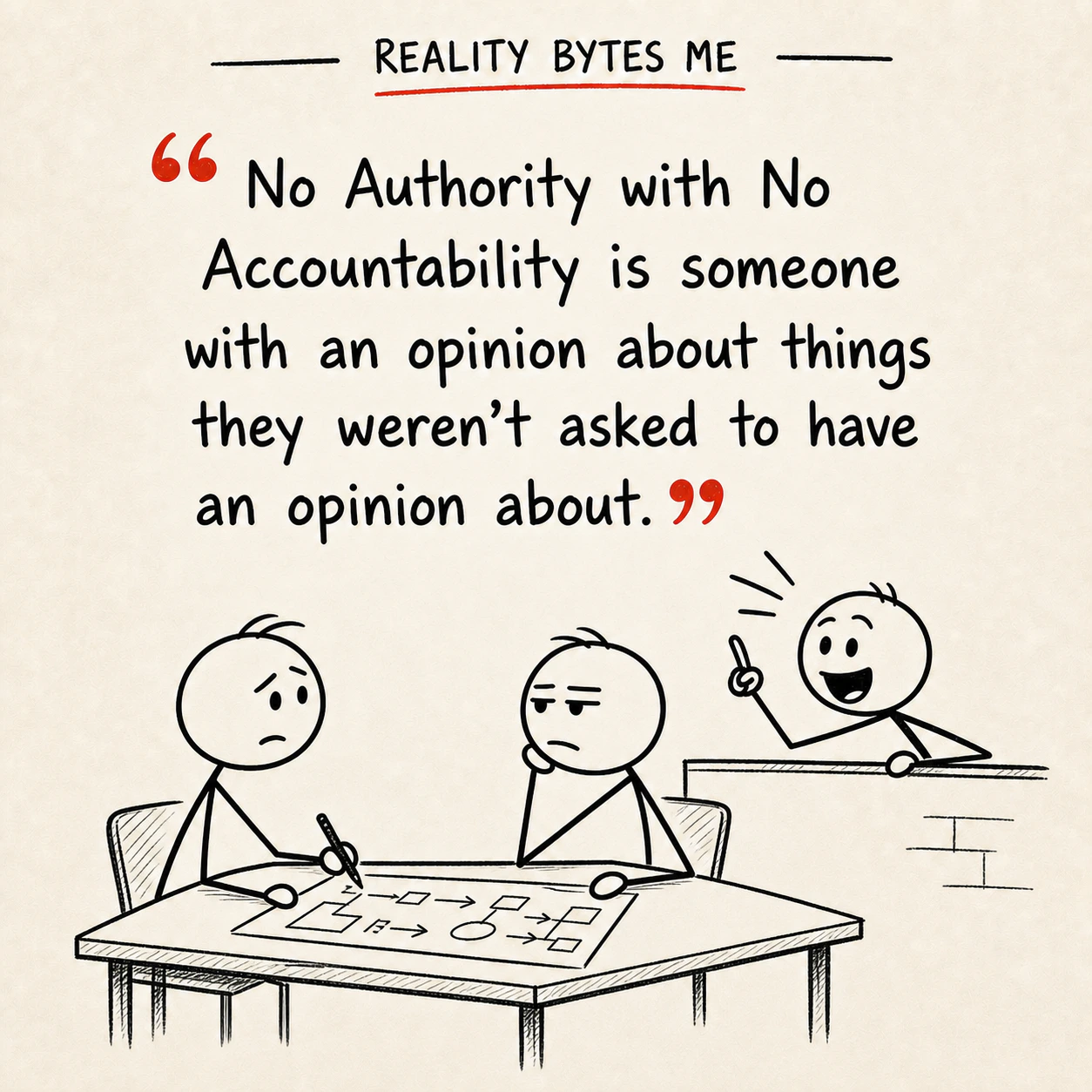
Two employees study a flowchart at a table while a cheerful figure leans over a partition, raises a finger and offers an unsolicited contribution. One worker looks worried; the other rests their head on a hand with visible impatience. The caption describes the combination of no authority and no accountability as having an opinion about things one was not asked to have an opinion about.
The cartoon concerns the cost difference between suggesting and implementing. An observer can propose a change without resolving its dependencies, explaining it to users or supporting it after release. The people at the table must evaluate the suggestion alongside everything they already know. Even a brief opinion can therefore create more work for its recipients than for the person who delivers it and then returns to their own responsibilities.
An outside perspective is not worthless merely because the speaker lacks authority. Useful ideas often come from people outside the formal decision structure. The distinction is whether a suggestion is offered as information or imposed as an obligation. A team should be able to consider it, ask for evidence and decide that another priority matters more without acquiring an indefinite duty to justify itself to the observer.
The partition makes the speaker's position clear. They are close enough to participate but separate from the work surface where the consequences have to be reconciled. The raised finger gives the interruption the familiar confidence of an answer arriving before the full question has been understood. The flowchart below suggests that the team is already dealing with a connected problem, not waiting for somebody to notice that alternatives exist.
A productive contribution explains the problem it solves, acknowledges the information the contributor lacks and accepts that the responsible team may make a different choice. The joke targets the version that skips those steps. Its confidence is easy to maintain because it never has to survive implementation, and its owner remains free to offer an equally confident alternative the next time they pass the partition.